
Gutter Installation & Repair in Poinciana, FL
Poinciana homes with long fascia runs and tight lot spacing need gutters set with proper pitch. We install seamless systems and replace aging runs.
Gutter Installation & Repair in Poinciana, Florida
Gutter systems in Poinciana must manage volume, discharge distance, and structural tie-ins together.
Our work focuses on matching gutter size to roof output and extending downspouts far enough to move discharge out of the consistently saturated zone around the home. On lanai-heavy homes, that often means adjusting exit points so water does not repeatedly test the same enclosure seam.
If you want to walk through what makes sense for your home and your village’s layout, call 863-390-2150 and we will explain what usually works here.
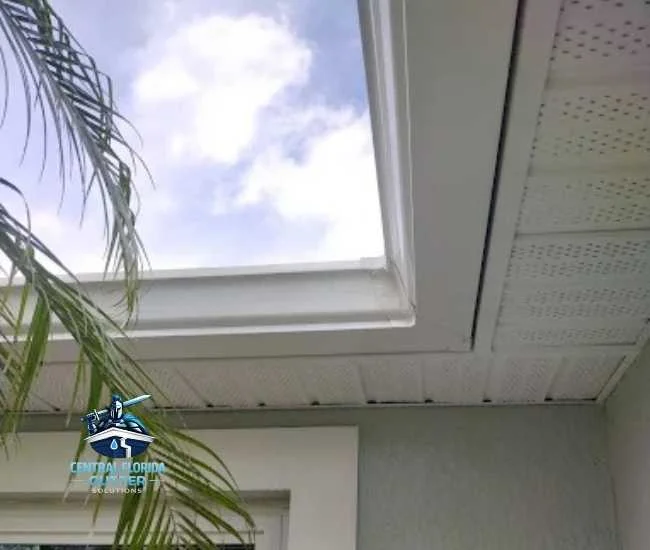
How Village Layout and Soil Conditions Shape Water Movement in Poinciana
In many early Poinciana villages, homes were designed with minimal drainage hardware, relying on grading and soil absorption. Around here, what usually happens next is that as landscaping settles and soil compacts, discharge no longer disperses the way it once did.
Extended screened enclosures also restrict airflow along rear elevations, slowing evaporation where gutters and fascia meet.
Sandy and loamy soil can shift quickly when moisture concentrates in one location. With a high water table, saturation tends to linger near the slab rather than drain deeply. In lanai-heavy homes, especially where the main roof meets a screened enclosure, concentrated runoff often tests the same joint repeatedly.
When roof valleys send more water into one section than the gutter can carry, overflow often lands near the foundation and saturates soil that cannot maintain its structure, which is usually when homeowners begin noticing washout, damp stucco, or settling pavers along the same edge. In Poinciana, the issue is rarely a single event. It is repeated discharge meeting soil that stays damp longer than expected.
Complete Gutter Solutions For Every Home
From installation and cleaning to replacement and guards, Central Florida Gutter Solutions provides complete gutter services designed to protect and maintain your home across Central Florida.
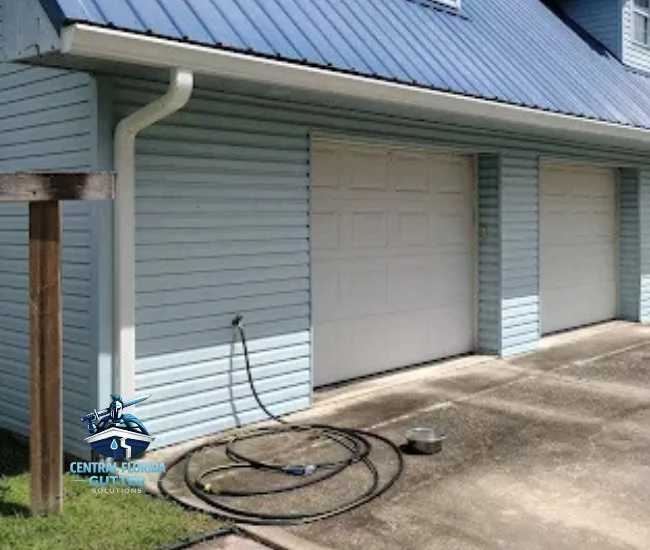
The Patterns Homeowners Notice First
Most homeowners in Poinciana do not reach out after one visible issue. They call when the same signs return in the same places, such as water entering the lanai along one seam or soil thinning along one stretch of foundation.
We see this most often in 1970s and 80s villages where original systems were undersized or absent, and in communities like Bellalago where large tile roofs concentrate discharge into fewer exit points.
If you are unsure whether what you are seeing is typical for your village layout or something that tends to progress, call 863-390-2150 and talk it through with us. layout or something that tends to progress, call 863-390-2150 and talk it through with us.
How Saturated Soil and Repeated Discharge Create Long-Term Damage
Gutter issues in Poinciana often follow a clear progression. Minor overshoot leads to repeated splash back, splash back keeps the base of the wall damp, and damp soil near the slab begins to soften. When discharge continues landing in the same area, water collects near the foundation and contributes to soil movement and gradual settlement, which is typically when homeowners begin noticing uneven pavers or widening gaps along the slab edge.
We often see lanai tie-in points where the gutter transitions across different roof sections without proper expansion joints, creating stress at those connection brackets.
In areas with a high water table, moisture does not retreat quickly, so the same saturated zone often remains vulnerable cycle after cycle. Waiting does not interrupt that pattern. It simply allows the softened, moisture heavy area to become more defined over time.
Built for Lanais and Village Layouts
Gutter systems in Poinciana must manage volume, discharge distance, and structural tie-ins together. Homes with screened lanais and pool cages require careful planning where rooflines connect.
Our work focuses on matching gutter size to roof output, correcting pitch so water drains fully, and extending downspouts far enough to move discharge out of the consistently saturated zone around the home.
If you want to walk through what makes sense for your home and your village’s layout, call 863-390-2150 and we will explain what usually works here.
How Poinciana’s Village Eras Shape Rooflines and Drainage
Poinciana’s housing developed in distinct phases, and each era was built with different drainage assumptions. In the earliest villages from the 1970s and 1980s, many ranch style homes featured simple rooflines and open grading that relied on natural soil absorption. Near Cypress Parkway and Poinciana Community Park, some properties were originally built without full gutter systems, increasing splash back along stucco bases and allowing moisture to linger near the slab.
As growth continued, communities such as Solivita introduced tile roofs and more complex gables that shed water efficiently but concentrate runoff at valleys and corners. In Bellalago, near Lake Tohopekaliga, higher water tables and established landscaping can further slow soil drying after discharge.
Two homes in different Poinciana villages may look similar at a glance, yet perform very differently once water leaves the roofline, and the difference usually comes down to the development era, roof design, lot grading, and how effectively discharge is directed away from the structure.
As those stressed joints shift slightly, hairline cracks can form along enclosure seams and trim lines before any major soil movement becomes visible.
If you would like to walk through what makes sense for your home in Poinciana, call 863 390 2150 and we can explain what typically works well in your specific village.
Real Questions Poinciana Homeowners Ask About Gutters
Understand the Pattern Before Moisture Becomes Structural
Water issues in Poinciana follow predictable paths shaped by village layout, roof design, soil behavior, and a consistently high water table. Once discharge begins reinforcing the same area, it becomes more defined over time.
Understanding how water is moving now makes it easier to adjust the system before soil movement, stucco staining, or structural wear become visible concerns.
If you want a clear picture of how your home is handling moisture and what usually comes next if nothing changes, call 863-390-2150 and we will walk through it with you.
Where Lanai Tie-Ins Change System Behavior
In Poinciana, especially in communities like Solivita and Bellalago, the rear roofline rarely functions as a simple straight run. Main roofs often intersect with screened lanais, pool cages, or extended patio covers. That intersection changes how the gutter system carries load.
At the tie-in point, two roof sections may drain toward a shared corner. The gutter in that location handles not only volume but directional force from different planes. If brackets are spaced uniformly without accounting for that concentration, the stress collects at the joint.
On one lanai-heavy home near Cypress Parkway, the main roof and enclosure roof met at a shallow angle. The gutter was properly sized, yet the corner miter was bearing more weight than the adjacent sections. Over time, that joint began separating slightly from the fascia. There was no dramatic spill. Instead, minor seepage appeared along the enclosure frame after sustained rain.
This type of issue is not about saturated soil or overflow alone. It is about how structural tie-ins redistribute force inside the system. When multiple planes converge, the hardware at that point must absorb more than straight runs do.
In villages with complex rooflines, understanding where roofs intersect is as important as calculating volume. The connection details determine whether the system stays stable year after year.
Rear Elevation Evaporation Limits
Another pattern in Poinciana involves reduced drying along rear walls. Screened lanais limit sunlight and airflow, especially on north-facing elevations.
When gutters hold residual moisture after storms, slower evaporation keeps seams and fascia boards damp longer than front elevations exposed to open air. The difference can be subtle but consistent.
We have seen rear sections show premature sealant breakdown while front runs remain intact. The system is draining, yet environmental conditions at the rear shorten material lifespan.
This is a ventilation and exposure dynamic rather than a capacity issue. On lanai-heavy homes, airflow patterns influence how long components stay wet, and that affects long-term stability.
Protect Your Home With Gutter Experts You Can Trust
From seamless gutter installations to reliable repairs, our team delivers clean workmanship, durable materials, and results that stand up to heavy rain. We make protecting your home simple and stress-free.