
Gutter Installation and Repair in Haines City, Florida
Gutter installation and repair in Haines City, Florida, designed for ridge elevation, steep rooflines, and high-velocity runoff.
Gutter Installation and Repair in Haines City, Florida
Homes in Haines City sit higher than much of Central Florida, so water leaves the roof faster. Along the Lake Wales Ridge, steep rooflines and sandy soil make gutter issues more about speed than volume.
Seasonal temperature swings on elevated ridge lots also cause fascia boards and gutter hangers to expand and contract slightly, which can shift alignment over time even when the system appears secure.
As roofs and landscaping change over time, the gutter system often stays the same. Water then moves faster than it was designed to handle, gradually affecting soil lines, slab edges, and fascia.
If you want to understand what water is doing around your home and what may happen next, call 863-390-2150.
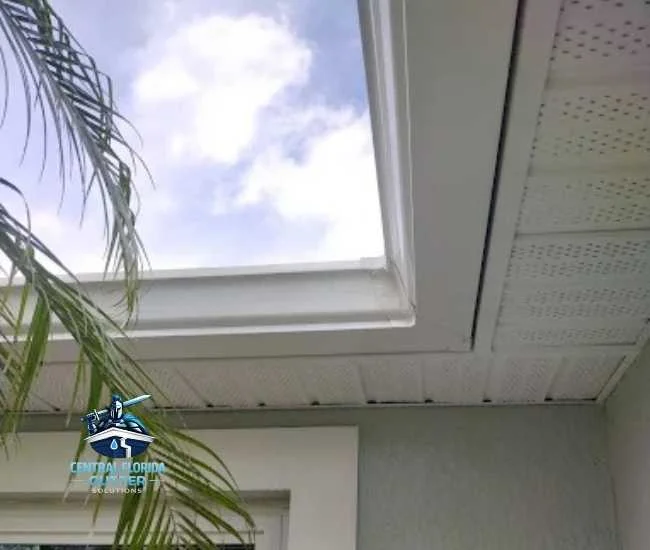
How Ridge Elevation and Sandy Ground Change Water Behavior in Haines City
What sets Haines City apart is elevation. On ridge properties, gravity adds speed before water reaches the gutter. As it accelerates down steep pitches and concentrates in valleys, it arrives at the roof edge with forward momentum instead of dropping straight down. That momentum can cause water to overshoot the gutter and land beyond the collection point, where it hits the ground at speed and moves outward across sandy soil.
Around here, water does not usually pool in one place. It spreads, chooses a route, and reinforces that path over time. When gutters do not slow and capture that movement correctly, water starts deciding where it goes next.
Complete Gutter Solutions For Every Home
From installation and cleaning to replacement and guards, Central Florida Gutter Solutions provides complete gutter services designed to protect and maintain your home across Central Florida.
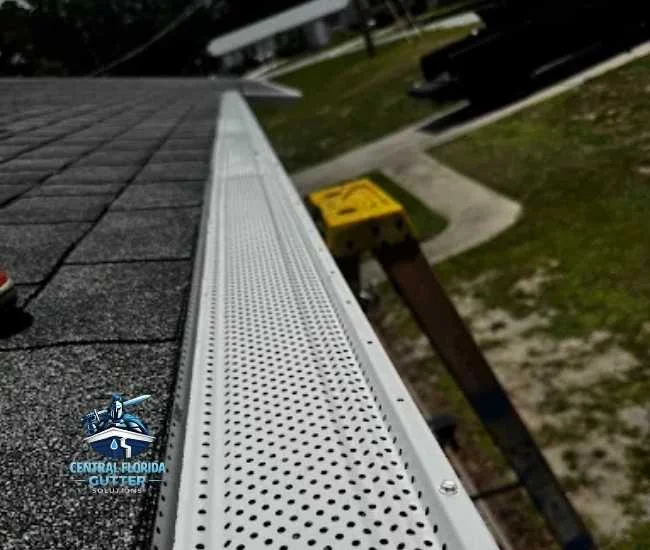
Repeated Warning Signs at Home
Most homeowners in Haines City do not call after a single sign. They reach out once the same issue keeps returning, like a shallow trench that slowly deepens or mulch that never seems to stay in place.
When water leaves the roof at speed and hits the same spot again and again, it teaches itself where to go next. Tracing that route back to its starting point is usually when the issue becomes clear.
When downspout outlets are undersized or spaced too far apart on long ridge runs, internal pressure builds during peak flow and forces water to stack inside the trough before it releases.
If those patterns sound familiar, call 863-390-2150. A short conversation often explains what the system is doing.
Why Fast-Moving Water Becomes Harder to Control Over Time on the Ridge
Water does not correct itself once it finds an easy route. When fast moving roof water overshoots the gutter, it lands beside the home and travels outward across sandy soil, leading to erosion below the surface. That is often when homeowners begin to notice settling, washout, or persistent changes along the foundation edge.
Because ridge soil drains quickly, these problems often develop quietly. The surface may look dry while the ground underneath continues to weaken. Waiting rarely simplifies the correction. It gives water more time to reinforce the same exit path.
Gutter Adjustments Built Around Speed, Slope, and Exit Control
Our work in Haines City focuses on controlling speed and exit points, not just catching water at the edge. That includes installation, repair, replacement, downspout routing, and targeted cleaning when flow is restricted.
On ridge properties, gutter size, mounting height, outlet placement, and downspout distance matter more than appearance. Systems often need adjustments that slow water before it reaches the edge and guide it farther away once it exits.
If you want to talk through what actually makes sense for your home, call 863-390-2150 and we will walk through it together.
What Haines City Roof Design and Elevation Demand From a Gutter System
Homes in Haines City span several building eras, each interacting with elevation differently.
Older homes near Railroad Avenue often feature exposed rafter tails and limited fascia, where improper mounting can allow water to run behind the gutter instead of into it. Mid-century ranch homes rely on long rooflines that concentrate water into fewer exit points, increasing speed before water ever reaches the edge. Different homes follow the same physics. Faster water needs more control.
Questions Haines City Homeowners Ask About Fast-Moving Water
When Attachment Points Start Working Against the System
On ridge homes in Haines City, speed is only part of the story. The way a gutter is fastened to the structure often determines whether it holds its line or slowly shifts out of position. On steeper roof pitches, the forward force of water does not just move outward, it pulls against hangers and spikes with repeated stress. Over time, even a slight outward tilt changes how the system receives water at the edge.
We see this most often on older homes near Railroad Avenue where fascia boards have aged or hardened. The gutter may still look straight from the ground, but along the run there can be subtle dips between fasteners. During a heavy afternoon storm, water reaches one of those low spots and gathers momentarily before pushing forward. That brief hesitation changes how the outlet performs and how the next section receives flow.
One homeowner noticed that a single seam kept separating every year despite resealing. The issue was not the seam. It was a slight fascia flex that allowed the run to move under load. Once the attachment points were reinforced and realigned, the separation stopped repeating.
On ridge properties, structural stability along the gutter line is just as critical as size or slope. If the system cannot hold position under force, performance changes gradually, even if the design was originally correct.
Outlet Geometry and Flow Transition Points
Not every ridge issue begins at the roof edge. Sometimes the transition from horizontal gutter to vertical downspout creates the bottleneck. If the drop outlet is cut too small or positioned at the wrong point along the run, water compresses before it turns downward.
On long, fast-moving sections, that compression changes how the gutter fills. Instead of a smooth directional shift, water collides with the outlet opening and rebounds slightly inside the trough. The result is subtle internal turbulence that weakens seams and stresses corners over time.
Adjusting outlet geometry or relocating the drop a few feet along the run can change how the entire system behaves, even without altering gutter size. On ridge homes, those small mechanical corrections often stabilize performance more effectively than replacing long sections unnecessarily.
Let’s Slow the Water Before It Chooses the Route
Over time, repeated splashback against soffit panels and trim can begin staining and softening materials long before ground movement becomes obvious.
Every home in Haines City teaches water how to move. On the ridge, water gains speed quickly and follows the easiest route available. When gutter systems are designed around roof pitch, elevation, and soil behavior, those routes stay controlled instead of becoming problems.
If you want help understanding what your home is doing with water and what usually comes next if nothing changes, call 863-390-2150
Protect Your Home With Gutter Experts You Can Trust
From seamless gutter installations to reliable repairs, our team delivers clean workmanship, durable materials, and results that stand up to heavy rain. We make protecting your home simple and stress-free.