
Gutter Installation & Repair in Fort Meade, Florida
Fort Meade homes with historic trims and long rooflines need gutters fitted carefully. We install seamless systems and replace worn sections.
Gutter Installation & Repair in Fort Meade, Florida
In several Fort Meade neighborhoods, aging roof decking and rafter tails have begun to flex slightly, altering how runoff meets the gutter edge.
Fort Meade homes sit on shifting ground, not flat subdivisions. Natural slope toward the Peace River, older wood framing, and shallow foundations all influence where runoff travels and where damage begins.
What we usually see here is repetition, not surprise. One downhill edge overflows. One fascia line stays dark. Soil beneath older pier homes slowly shifts in the same direction each season.
If you want to review what you are seeing before it becomes rot or settling, call 863-390-2150 and we will walk through it with you.
Where Gravity Takes the Water
Fort Meade is not level ground. Homes near Hoot Owl Hill or closer to the river basin experience steady gravitational pull once water leaves the roof. Even mild elevation adds speed to runoff.
Steep gable roofs and long eaves release water toward downhill corners. When volume meets a small restriction, backup begins at the lowest edge first. That is why one side of the home often shows stress while the rest appears fine.
Complete Gutter Solutions For Every Home
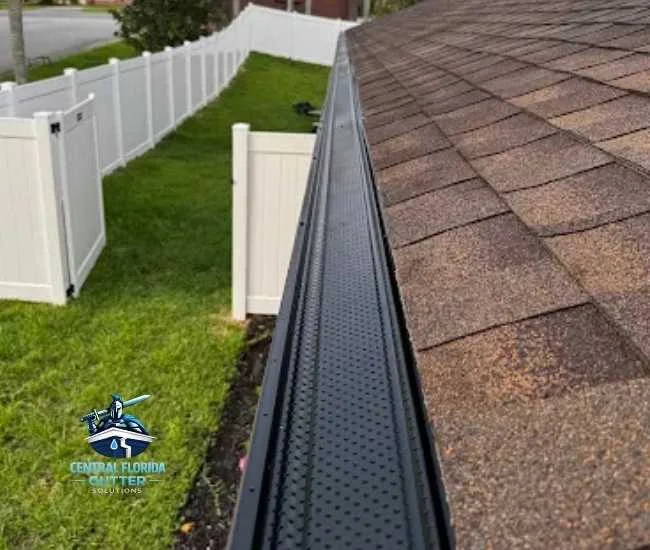
From installation and cleaning to replacement and guards, Central Florida Gutter Solutions provides complete gutter services designed to protect and maintain your home across Central Florida.
When the Downhill Side Always Gets Hit
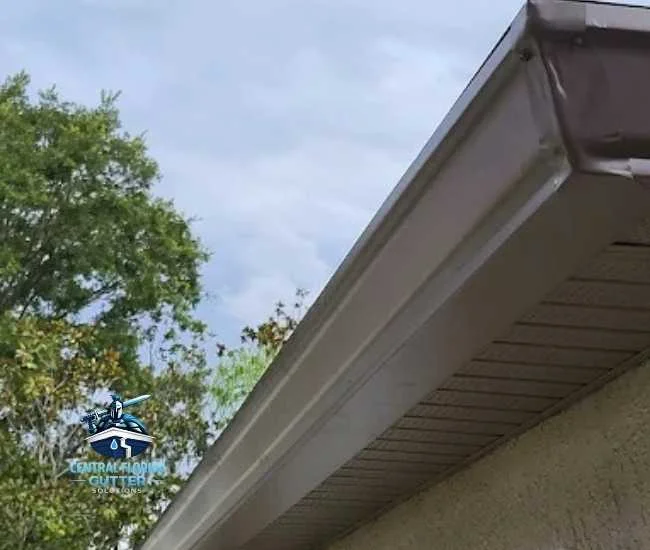
We also evaluate outlet sizing and elbow configuration at downhill exits, since tight turns can create internal turbulence that slows flow before it reaches the ground.
Most homeowners call after noticing the same corner handling most of the flow. Soil beneath that edge stays darker. Mulch shifts. Splash marks appear along lower siding.
We trace how roof planes feed into that downhill section and measure how far discharge travels once it leaves the downspout. In Fort Meade, gravity continues working long after water exits the gutter. If discharge stops too close to pier foundations or crawlspaces, it cycles back toward the structure.
Calling 863-390-2150 early allows us to identify concentration points before framing or subflooring is affected.
How Minor Overflow Turns Structural Here
Drainage escalates faster in Fort Meade than in flatter towns. Many homes rest on piers or shallow foundations, which means runoff does not simply affect landscaping. It can migrate beneath the structure.
Local soils contain sand mixed with fine phosphate residue. When saturated repeatedly, they shift unevenly. That movement shows up later as porch settling, walkway separation, or uneven crawlspace moisture.
Humidity adds weight to fascia and rafter tails that already carry seasonal moisture. Over time, minor pitch changes become consistent misalignment.
Built for Slope and Soil Movement
Gutter systems in Fort Meade must account for gravity, debris load, and discharge distance together.
We install six-inch seamless aluminum systems sized for concentrated roof runoff, reinforce downhill corners where load increases, and extend discharge far enough to prevent water from re-entering pier zones or crawlspaces.
If you want to review what typically works for homes in your part of Fort Meade, call 863-390-2150 and we will explain what we usually see.
How Building Era Changes Drainage
Historic District homes rely on original wood fascia and exposed rafter tails that respond quickly to trapped moisture. Mid-century ranch homes concentrate runoff at long downhill edges.
Newer block homes may look structurally different, but elevation and roof geometry still dictate where water lands. Two homes on the same street can behave very differently depending on grade and foundation depth.
In Fort Meade, slope often matters more than age.
As moisture lingers along beam pockets and joist ends, subtle wood expansion can begin before visible settling or crawlspace odor appears.
When Roof Edges Drift Out of Plane
In Fort Meade, slope explains where water travels, but it does not always explain why one section fails sooner than another. Over decades, roof edges can shift slightly as rafter tails absorb humidity and dry repeatedly. That movement is minor, yet it changes how evenly the gutter sits against the drip edge.
On homes near Hoot Owl Hill, we often find that one downhill run has developed a slight twist. From the driveway, the system appears straight. Up close, the fascia line has dipped between attachment points, breaking the seal along a short section. During steady flow, a portion of runoff tracks behind the gutter rather than entering the trough cleanly. The issue looks like downhill overload, but the root cause is alignment.
We recently evaluated a pier home where staining appeared only along one fascia board. Capacity was correct. Discharge distance was adequate. The mounting surface had shifted just enough to redirect water behind the metal.
Correcting this involves restoring consistent attachment, reinforcing weakened rafter tails, and resetting pitch across the full span. When the gutter body sits square to the roof plane again, flow stabilizes without changing size or layout.
Bracket Compression at Downhill Corners
Downhill corners in Fort Meade carry sustained load over long roof runs. Over time, hanger brackets at those corners compress wood fibers around their fasteners. The screws remain tight, but the surrounding material yields slightly.
That compression changes the internal angle of the gutter. Instead of draining fully between storms, a shallow layer of water can remain at the lowest section. The added weight increases stress on the same bracket cluster, accelerating the shift.
Homeowners may notice minor seam separation or faint drips before any obvious overflow. Reinforcing attachment points and redistributing bracket spacing allows load to transfer evenly along the fascia rather than concentrating at one stressed edge.
Questions We Hear in Fort Meade
Get Ahead of Water Before It Reaches the Structure
Homes in Fort Meade teach water where to go over time. Roof design, debris load, gravity, and foundation type work together to send runoff toward the same weak points again and again. When gutter systems are designed around local slope and construction, those patterns stay controlled instead of escalating.
If you want to understand how water is moving around your home and what usually works here, call 863-390-2150. We will help you see the full picture before damage sets in.
Protect Your Home With Gutter Experts You Can Trust
From seamless gutter installations to reliable repairs, our team delivers clean workmanship, durable materials, and results that stand up to heavy rain. We make protecting your home simple and stress-free.